

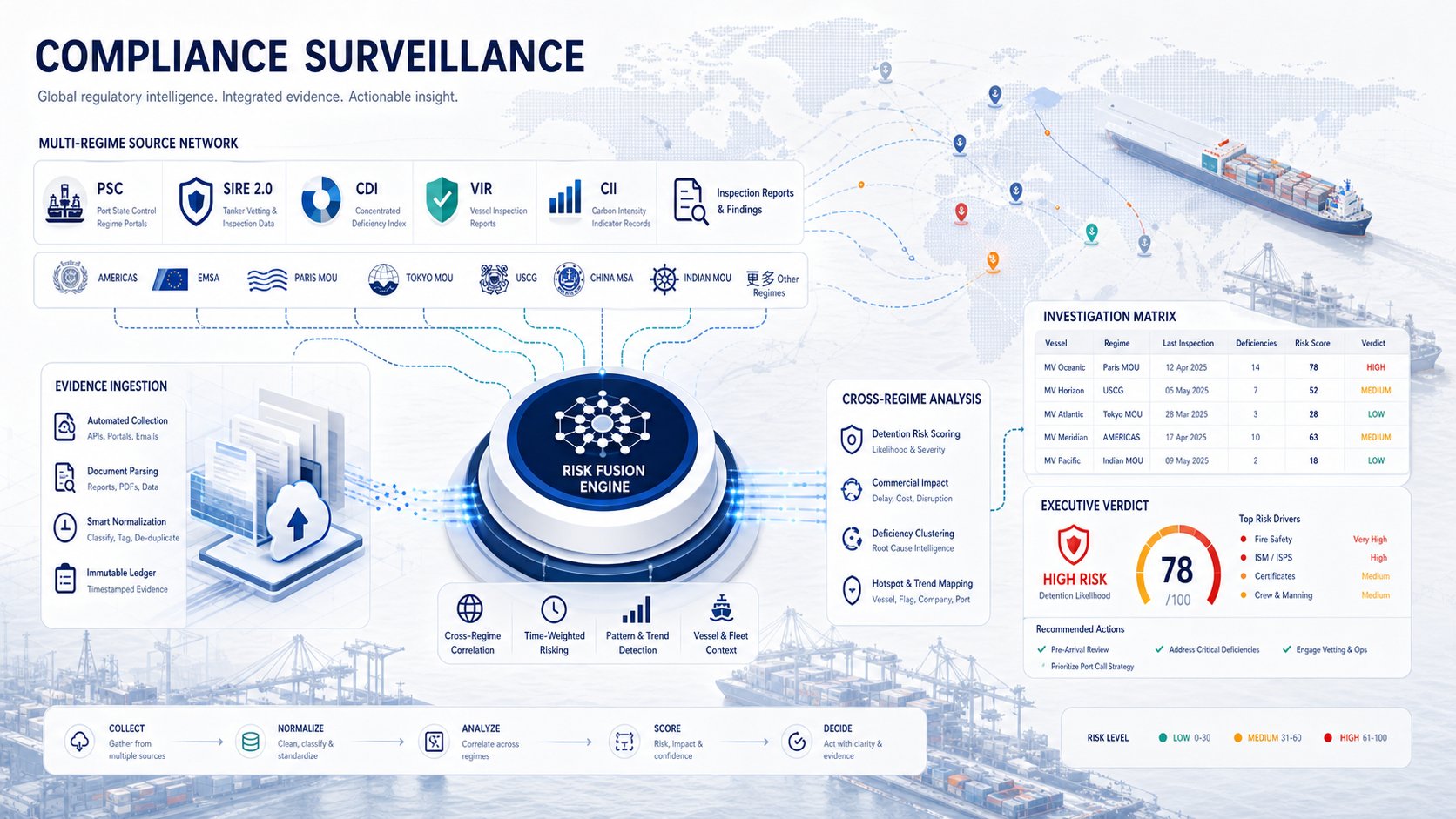
Compliance Surveillance — five regulatory regimes (PSC, SIRE 2.0, CDI, VIR, CII) read together, scored, and routed to one ranked verdict.
The Compliance Surveillance pipeline reads all five together. Detention risk depends on more than just PSC; commercial-charter eligibility depends on more than just SIRE. The pipeline produces one ranked verdict — what’s most likely to bite, in what regime, and what to do about it.
Where the data comes from
Each regime publishes its data through a different surface. The pipeline pulls from each independently:| Regime | Source |
|---|---|
| PSC | Port-state-control regime portals (see logo grid below) |
| SIRE 2.0 |  OCIMF SIRE 2.0 portal OCIMF SIRE 2.0 portal |
| CDI |  CDI — Chemical Distribution Institute portal CDI — Chemical Distribution Institute portal |
| VIR | Vessel ERP inspection module + email correspondence |
| CII | Emissions pipeline — derived from noon reports + bunker records |
PSC regime portals
| MoU / Authority | Region | |
|---|---|---|
 | Paris MoU | Europe + N. Atlantic |
 | Tokyo MoU | Asia-Pacific |
 | Indian Ocean MoU | Indian Ocean rim |
 | Mediterranean MoU | Mediterranean basin |
 | Caribbean MoU | Caribbean basin |
 | Black Sea MoU | Black Sea region |
 | Abuja MoU | West & Central Africa |
 | US Coast Guard (USCG) | United States |
 | Riyadh MoU | Gulf states |
Regime by regime
PSC
The most operationally consequential regime. A PSC inspection produces deficiencies and (in severe cases) a detention. Every regime has its own MoU (Paris MoU, Tokyo MoU, Riyadh, AMSA, USCG, Latin American), each with a target factor that drives inspection probability per port call. The pipeline tracks:- Open PSC deficiencies (deficiency code, severity, action taken, ranking)
- Detention history (when, where, what was the cause, how long held)
- Repeat themes (same deficiency code appearing on multiple inspections)
- Recent inspection density at the next port’s regime
- Crew / SMS deficiencies (often correlated to fatigue, training gaps)
SIRE 2.0
OCIMF’s tanker vetting programme. SIRE 2.0 (the 2023 rewrite) replaced binary deficiency findings with a more nuanced observation severity scale:
The pipeline pulls historical SIRE observations and the most recent inspection record, classifies findings by severity, and tracks operator response status — observations have a maximum response window after which the OCIMF system marks them outstanding.
CDI
The chemical-tanker analogue to SIRE. Inspection produces ship and barge inspection reports (SIR / BIR). Same response-window logic; same observation severity tracking. The pipeline pulls the last-CDI details per vessel and tracks the inspection cycle.VIR
Charterer- and owner-led inspections. Variable severity vocabulary, normalised the same way as the defects pipeline. VIR findings often pre-empt SIRE / CDI findings — a charterer’s inspector finds something today that the OCIMF inspector would have found at the next vetting if it weren’t fixed first.CII
The carbon side. The emissions data pipeline handles the data acquisition; the compliance pipeline tracks the rating trend:- Current attained vs required CII for the year
- Year-over-year delta in attained
- Projected end-of-year rating band (A / B / C / D / E)
- Regulatory consequence: a vessel rated D for 3 consecutive years or E for 1 year requires a SEEMP III update with corrective measures
Cross-regime fleet view
A fleet-wide compliance dashboard composes the per-vessel records:Detention-risk scoring
A weighted composite combines four signals:
The composite maps to LOW / MEDIUM / HIGH / CRITICAL. HIGH or CRITICAL routes the case to the Technical Superintendent with the contributing factors.
Commercial-impact scoring
A parallel score covers vetting and charterer exposure: A CII rating dropping to E carries a binary indicator weight because the regulatory consequence is binary.Investigation matrix
When a finding lands, the pipeline classifies it through an investigation matrix:
A “training” root cause repeating across the fleet is a different conversation than a “technical” root cause on one vessel. The matrix exists so the response is calibrated to the actual problem.
CII trajectory
For the carbon dimension, the analyzer tracks attained CII through the operating year: \text{CII}_\text{attained}(t) = \frac{\sum_{i=1}^{t} \text{CO}_2_i}{\sum_{i=1}^{t} \text{Capacity} \cdot \text{Distance}_i} Compared against the IMO required CII for the year and the boundary lines for A–E ratings. A trajectory that’s tracking the D/E boundary is flagged early so operational changes can intervene before the year closes.Worked example
MV OCEAN, end-of-April compliance review:
Repeat themes:
- Crew familiarity finding in PSC (Houston) and SIRE (Houston, separate inspection) — same root cause, two regimes.
- ECDIS update finding repeats across last two SIRE inspections — procedural gap not closed.
- Routes the SIRE Severity 3 response to crewing — operator response due in 8 days, must not lapse.
- Routes the CII trajectory to the voyage pipeline for operational-change recommendation (slow-steaming candidate; route review).
- Generates a repeat-theme remediation plan covering crew familiarity training across the fleet, not just OCEAN.
- Flags ECDIS update procedure to QHSE for SMS revision.
What the senior review contains
- Headline — overall compliance posture, detention-risk and commercial-impact scores.
- PSC — open deficiencies with severity, detention history, regime risk.
- SIRE 2.0 — observation count by severity, response status, time to response window.
- CDI — last inspection findings, response status (where applicable).
- VIR — open observations, charterer / owner.
- CII — current and projected rating, year-over-year delta, SEEMP III implications.
- Repeat themes — findings appearing across regimes or inspections, with root-cause classification.
- Recommendations — prioritised by deadline and impact.
- Escalation decision — to whom, and why.
Escalation triggers
Why all five together
A vessel with a clean SIRE record, a clean CII rating, but a fresh PSC detention is in trouble. A vessel with a clean PSC record but a CII trajectory falling off the cliff is also in trouble — different timeline, different audience. Reading the regimes together produces the only honest answer to “is this vessel commercially and operationally compliant?”References
Source templates
SIRE / CDI monitoring suite — historical SIRE observations, inspection records, last-CDI details, fleet-wide SIRE / CDI status.
Related: Class
Class CoCs feed PSC detention probability — overlap with the class pipeline.
Related: Defects
PSC, SIRE, CDI, VIR findings live in both pipelines — defects gives the operational view.
Related: Emissions
CII rating is computed from emissions data — that’s where the numbers come from.