

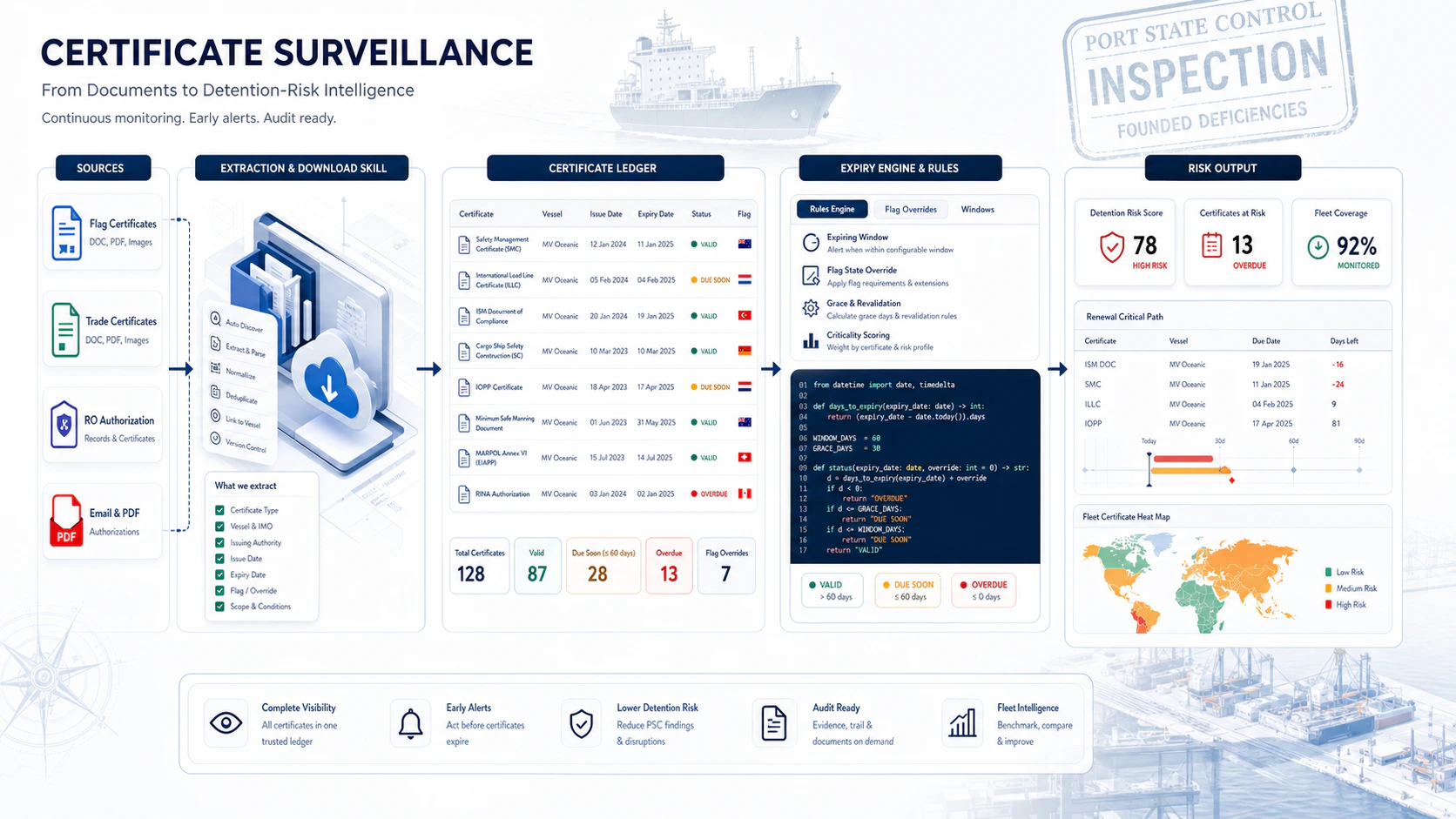
Certificate Surveillance — flag, statutory, and trade certificates tracked from authority sources through expiry classification to PSC detention-risk scoring.
Where the data comes from
Each flag and class society publishes certificates differently — some via portal, some via PDF email. The pipeline normalises every source into the same record shape.
The portfolio
A typical vessel carries 30–50 certificates beyond the class set:- Statutory certificates — flag-issued under SOLAS, MARPOL, MLC, ISM, ISPS, BWM, IHM
- Trade-specific — IOPP, ISPP, SOPEP, GAS Code, Chemical Code, Polar Code (where relevant)
- Vessel registration — registry certificate, continuous synopsis record
- Insurance — P&I, H&M (typically renewed annually)
- Wireless / radio — cargo ship safety radio
- Operational — minimum safe manning, fitness certificates aggregate
How a verdict is produced
Effective expiry
Same logic the class pipeline uses for class certificates: Days remaining drives the verdict:Window classification
Flag-specific overrides
Some flags issue full-term certificates that supersede class-issued versions for specific instruments. The most common case is Panama issuing full-term BWMC, IHM, ISSC, or security certificates — these read as expired in the class portal but are administratively in order. The pipeline applies the same flag-aware logic the class pipeline uses:Detention-risk scoring
A composite weighted by certificate type and window urgency: Type weights reflect that not all certificates carry equal PSC detention risk:
Long-lead-survey renewals get an additional multiplier — they can’t be rushed at the next port call. The composite maps to LOW / MEDIUM / HIGH / CRITICAL.
Renewal lead-time
For each certificate due within the next 180 days, the pipeline computes the renewal critical path:- Survey requirement (in-port vs underway)
- Surveyor availability at the planned port
- Document preparation lead-time
- Flag administration processing time
Worked example
MV POSUN, Panama-flagged, mid-April review:
Detention-risk score: MEDIUM — driven by the IAPP renewal in 21 days. A surveyor is required and the vessel is currently mid-passage, due Singapore in 11 days. Lead-time tight but feasible.
The pipeline:
- Routes the IAPP renewal to the Marine Superintendent for surveyor coordination.
- Logs the BWMC override (no action needed).
- Schedules the next review for the Cargo Ship Safety Equipment certificate at the 14-day mark.
Multi-vessel rollup
For fleet-wide reviews, the pipeline produces a heat-map style table — one row per vessel, one column per certificate type, colour-coded by expiry window. A reviewer scans across the row to see how exposed any given vessel is, and down the column to see if any certificate type is systematically under-managed across the fleet. A column with five vessels in the HIGH bucket but spread across different expiry months usually points to a process gap (renewal-coordinator capacity); a column with five vessels in HIGH bucket clustered in the same month points to a calendar artefact (whole class certificated together at delivery, all coming due together).What the senior review contains
- Portfolio table — every certificate with effective expiry and verdict.
- Renewal timeline — upcoming renewals grouped by urgency window.
- Detention-risk score — composite with contributing factors.
- Lead-time gaps — renewals with insufficient runway to the next port.
- Flag overrides — certificates that look expired but aren’t (with reason).
- Recommendations — prioritised by deadline.
- Escalation decision — to whom, and why.
Escalation triggers
Why this is its own pipeline
Class certificates are managed in a portal with their own rhythm. Statutory certificates touch flag administration, insurance brokers, charterer requirements, and PSC inspection regimes — different audience, different timeline, different intervention pattern. Keeping them separate means the senior review for each can be ranked appropriately and routed to the right superintendent.References
Related: Class
Class certificates and surveys — separate pipeline with the same expiry and override logic.
Related: Compliance
PSC detention risk integrates certificate state with inspection findings and CII rating.
Related: Crew
Crew-side certificates (CoC, GMDSS, STCW endorsements, medicals) are tracked in the crew pipeline.
Related: Flag circulars
Some certificate renewal procedures depend on the latest flag circulars — keep the document corpus current.