> ## Documentation Index
> Fetch the complete documentation index at: https://docs.appliedaifoundation.org/llms.txt
> Use this file to discover all available pages before exploring further.
# Certificate Surveillance
> Statutory and trade certificate portfolio tracking — expiry windows, authority gaps, renewal lead-time, and PSC detention-risk scoring.
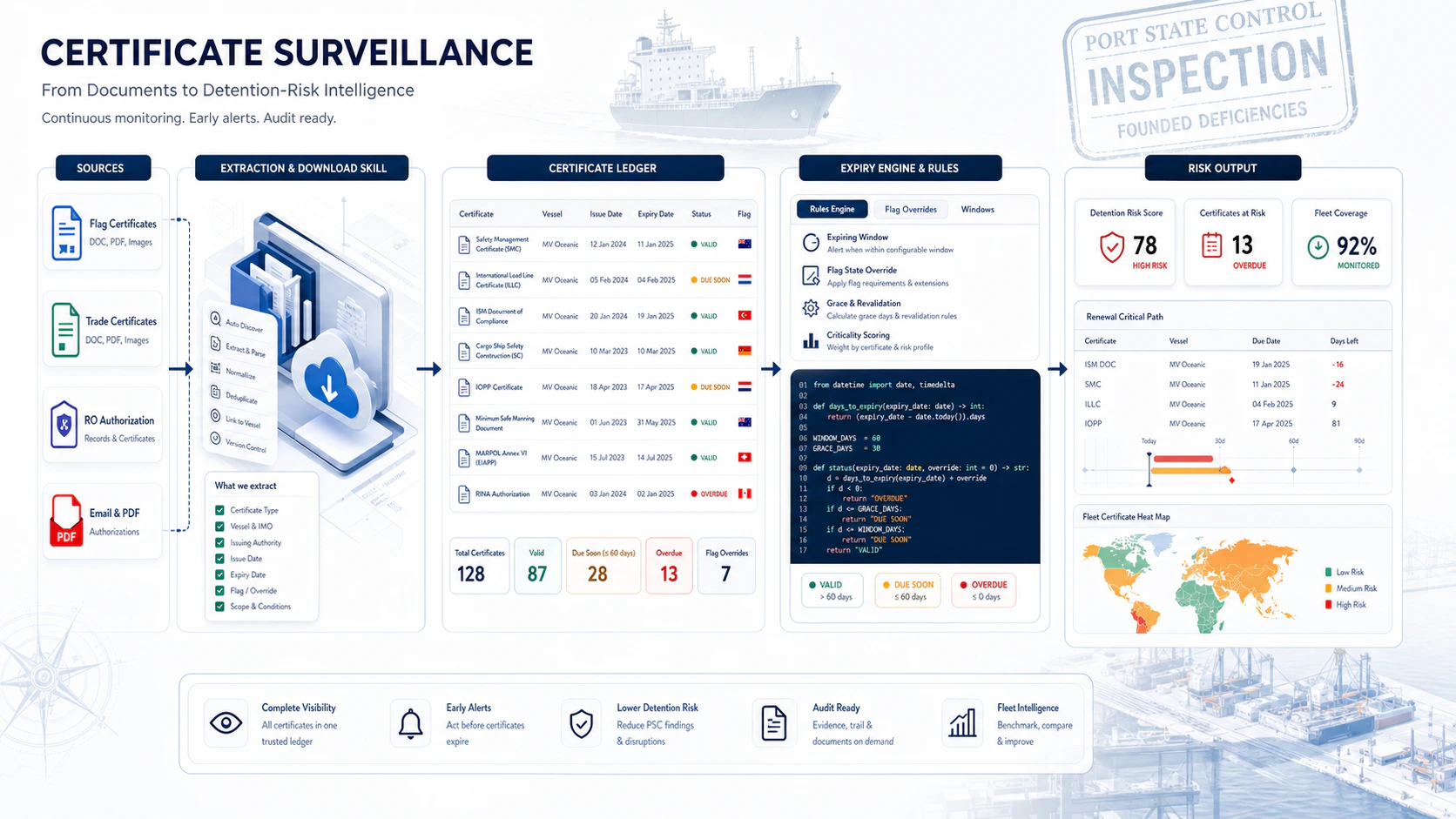 The class pipeline handles class certificates. Everything else — flag-issued statutory certificates, trade-specific certificates, crew-related vessel-side certificates — belongs here. A vessel detained at PSC because a flag-issued certificate expired three weeks ago is the most preventable kind of detention there is.
Certificates rarely fail in interesting ways. They expire. The work is structural: making sure every certificate is being tracked, every expiry window is being watched, every renewal has lead-time, and the rare flag-specific edge case (Panama BWMC full-term, etc.) doesn't trigger a false-positive overdue.
***
## Where the data comes from
| Source | What it provides |
| ------------------------------------------------------------ | ----------------------------------------------------------- |
| **Flag administration portals** | Statutory certificate validity, dispensations, endorsements |
| **Class portals (ABS, BV, DNV, LR, NK, CCS, KR, IRS, RINA)** | Class-issued statutory certificates and SoCs |
| **Vessel ERP (certificates module)** | Master register, scanned PDFs, renewal-coordination notes |
| **Insurance broker correspondence** | P\&I and H\&M certificates of entry |
| **Recognised Organisation (RO) database** | Authorisation status per flag |
Each flag and class society publishes certificates differently — some via portal, some via PDF email. The pipeline normalises every source into the same record shape.
***
## The portfolio
A typical vessel carries 30–50 certificates beyond the class set:
* **Statutory certificates** — flag-issued under SOLAS, MARPOL, MLC, ISM, ISPS, BWM, IHM
* **Trade-specific** — IOPP, ISPP, SOPEP, GAS Code, Chemical Code, Polar Code (where relevant)
* **Vessel registration** — registry certificate, continuous synopsis record
* **Insurance** — P\&I, H\&M (typically renewed annually)
* **Wireless / radio** — cargo ship safety radio
* **Operational** — minimum safe manning, fitness certificates aggregate
Each certificate has an issue date, an expiry date, sometimes an extension date (administrative or flag-issued), and an issuing authority.
***
## How a verdict is produced
### Effective expiry
Same logic the [class pipeline](/skills/class) uses for class certificates:
$$
D_\text{effective} = \max(D_\text{expiry}, \; D_\text{extension})
$$
Days remaining drives the verdict:
$$
\Delta_\text{days} = D_\text{effective} - D_\text{today}
$$
### Window classification
| Window | Bucket | Action |
| --------------- | -------- | ------------------------------------------- |
| Already expired | CRITICAL | Vessel non-compliant — escalate immediately |
| 0–30 days | HIGH | Renewal urgent |
| 31–90 days | MEDIUM | Renewal in planning |
| 91–180 days | LOW | Track |
| Beyond 180 days | OK | Routine |
### Flag-specific overrides
Some flags issue full-term certificates that supersede class-issued versions for specific instruments. The most common case is Panama issuing full-term BWMC, IHM, ISSC, or security certificates — these read as expired in the class portal but are administratively in order.
The pipeline applies the same flag-aware logic the class pipeline uses:
```python theme={"system"}
if days_diff <= 0:
name = cert.get("certificateName", "").lower()
if any(t in name for t in ("ballast", "bwm", "hazardous", "ihm",
"security", "issc")) and "panama" in vessel_flag:
verdict = "Full term certificate — flag-issued"
severity = None # Not overdue
else:
verdict = "Overdue"
severity = "CRITICAL"
```
Without the override, a Panama-flagged vessel with a fully flag-issued BWMC produces a false-positive overdue verdict every review cycle. The override eliminates the noise.
***
## Detention-risk scoring
A composite weighted by certificate type and window urgency:
$$
R_\text{psc} = \sum_i \left( w_\text{type}(c_i) \cdot w_\text{window}(c_i) \right)
$$
Type weights reflect that not all certificates carry equal PSC detention risk:
| Certificate type | Weight |
| -------------------------------------------- | -----: |
| Statutory (SOLAS / MARPOL / MLC / IOPP) | 5 |
| Class (Hull / Machinery / Cargo Ship Safety) | 4 |
| Trade-specific (BWMC / IHM / ISSC) | 3 |
| Insurance (P\&I / H\&M) | 2 |
| Other (registry / wireless / etc.) | 1 |
Long-lead-survey renewals get an additional multiplier — they can't be rushed at the next port call. The composite maps to LOW / MEDIUM / HIGH / CRITICAL.
***
## Renewal lead-time
For each certificate due within the next 180 days, the pipeline computes the renewal critical path:
1. Survey requirement (in-port vs underway)
2. Surveyor availability at the planned port
3. Document preparation lead-time
4. Flag administration processing time
A renewal that needs 21 days lead-time but the vessel reaches the next port in 14 has a problem. The pipeline surfaces these timing gaps so a Marine Superintendent can intervene before the certificate window closes.
***
## Worked example
`MV POSUN`, Panama-flagged, mid-April review:
| Certificate | Expiry | Δ days | Verdict |
| ------------------------------ | ---------- | -----: | ---------------------------------- |
| Cargo Ship Safety Construction | 2026-09-12 | 134 | OK |
| Cargo Ship Safety Equipment | 2026-06-04 | 35 | MEDIUM |
| MARPOL Annex VI / IAPP | 2026-05-21 | 21 | HIGH |
| BWMC | 2026-04-08 | -7 | Full term — flag-issued (override) |
| MLC | 2026-08-30 | 121 | LOW |
| P\&I | 2027-02-20 | 295 | OK |
| Continuous Synopsis Record | 2026-12-01 | 214 | OK |
**Detention-risk score**: MEDIUM — driven by the IAPP renewal in 21 days. A surveyor is required and the vessel is currently mid-passage, due Singapore in 11 days. Lead-time tight but feasible.
The pipeline:
1. Routes the IAPP renewal to the Marine Superintendent for surveyor coordination.
2. Logs the BWMC override (no action needed).
3. Schedules the next review for the Cargo Ship Safety Equipment certificate at the 14-day mark.
***
## Multi-vessel rollup
For fleet-wide reviews, the pipeline produces a heat-map style table — one row per vessel, one column per certificate type, colour-coded by expiry window. A reviewer scans across the row to see how exposed any given vessel is, and down the column to see if any certificate type is systematically under-managed across the fleet.
A column with five vessels in the HIGH bucket but spread across different expiry months usually points to a process gap (renewal-coordinator capacity); a column with five vessels in HIGH bucket clustered in the same month points to a calendar artefact (whole class certificated together at delivery, all coming due together).
***
## What the senior review contains
1. **Portfolio table** — every certificate with effective expiry and verdict.
2. **Renewal timeline** — upcoming renewals grouped by urgency window.
3. **Detention-risk score** — composite with contributing factors.
4. **Lead-time gaps** — renewals with insufficient runway to the next port.
5. **Flag overrides** — certificates that look expired but aren't (with reason).
6. **Recommendations** — prioritised by deadline.
7. **Escalation decision** — to whom, and why.
***
## Escalation triggers
| Trigger | Severity |
| ------------------------------------------------------- | -------- |
| Any statutory certificate expired (no override applies) | CRITICAL |
| Mandatory certificate missing | CRITICAL |
| Renewal lead-time insufficient for next port call | HIGH |
| Multiple HIGH-window renewals with no plan | HIGH |
| Detention-risk score = HIGH or CRITICAL | CRITICAL |
| RO authorisation lapsed | HIGH |
***
## Why this is its own pipeline
Class certificates are managed in a portal with their own rhythm. Statutory certificates touch flag administration, insurance brokers, charterer requirements, and PSC inspection regimes — different audience, different timeline, different intervention pattern. Keeping them separate means the senior review for each can be ranked appropriately and routed to the right superintendent.
The single highest-leverage data-quality investment in certificate management is keeping the issuing-authority field complete. A certificate without an issuing authority can't be resolved — every renewal starts with "who do we contact?", and the answer is in the certificate metadata.
***
## References
Class certificates and surveys — separate pipeline with the same expiry and override logic.
PSC detention risk integrates certificate state with inspection findings and CII rating.
Crew-side certificates (CoC, GMDSS, STCW endorsements, medicals) are tracked in the crew pipeline.
Some certificate renewal procedures depend on the latest flag circulars — keep the document corpus current.
The class pipeline handles class certificates. Everything else — flag-issued statutory certificates, trade-specific certificates, crew-related vessel-side certificates — belongs here. A vessel detained at PSC because a flag-issued certificate expired three weeks ago is the most preventable kind of detention there is.
Certificates rarely fail in interesting ways. They expire. The work is structural: making sure every certificate is being tracked, every expiry window is being watched, every renewal has lead-time, and the rare flag-specific edge case (Panama BWMC full-term, etc.) doesn't trigger a false-positive overdue.
***
## Where the data comes from
| Source | What it provides |
| ------------------------------------------------------------ | ----------------------------------------------------------- |
| **Flag administration portals** | Statutory certificate validity, dispensations, endorsements |
| **Class portals (ABS, BV, DNV, LR, NK, CCS, KR, IRS, RINA)** | Class-issued statutory certificates and SoCs |
| **Vessel ERP (certificates module)** | Master register, scanned PDFs, renewal-coordination notes |
| **Insurance broker correspondence** | P\&I and H\&M certificates of entry |
| **Recognised Organisation (RO) database** | Authorisation status per flag |
Each flag and class society publishes certificates differently — some via portal, some via PDF email. The pipeline normalises every source into the same record shape.
***
## The portfolio
A typical vessel carries 30–50 certificates beyond the class set:
* **Statutory certificates** — flag-issued under SOLAS, MARPOL, MLC, ISM, ISPS, BWM, IHM
* **Trade-specific** — IOPP, ISPP, SOPEP, GAS Code, Chemical Code, Polar Code (where relevant)
* **Vessel registration** — registry certificate, continuous synopsis record
* **Insurance** — P\&I, H\&M (typically renewed annually)
* **Wireless / radio** — cargo ship safety radio
* **Operational** — minimum safe manning, fitness certificates aggregate
Each certificate has an issue date, an expiry date, sometimes an extension date (administrative or flag-issued), and an issuing authority.
***
## How a verdict is produced
### Effective expiry
Same logic the [class pipeline](/skills/class) uses for class certificates:
$$
D_\text{effective} = \max(D_\text{expiry}, \; D_\text{extension})
$$
Days remaining drives the verdict:
$$
\Delta_\text{days} = D_\text{effective} - D_\text{today}
$$
### Window classification
| Window | Bucket | Action |
| --------------- | -------- | ------------------------------------------- |
| Already expired | CRITICAL | Vessel non-compliant — escalate immediately |
| 0–30 days | HIGH | Renewal urgent |
| 31–90 days | MEDIUM | Renewal in planning |
| 91–180 days | LOW | Track |
| Beyond 180 days | OK | Routine |
### Flag-specific overrides
Some flags issue full-term certificates that supersede class-issued versions for specific instruments. The most common case is Panama issuing full-term BWMC, IHM, ISSC, or security certificates — these read as expired in the class portal but are administratively in order.
The pipeline applies the same flag-aware logic the class pipeline uses:
```python theme={"system"}
if days_diff <= 0:
name = cert.get("certificateName", "").lower()
if any(t in name for t in ("ballast", "bwm", "hazardous", "ihm",
"security", "issc")) and "panama" in vessel_flag:
verdict = "Full term certificate — flag-issued"
severity = None # Not overdue
else:
verdict = "Overdue"
severity = "CRITICAL"
```
Without the override, a Panama-flagged vessel with a fully flag-issued BWMC produces a false-positive overdue verdict every review cycle. The override eliminates the noise.
***
## Detention-risk scoring
A composite weighted by certificate type and window urgency:
$$
R_\text{psc} = \sum_i \left( w_\text{type}(c_i) \cdot w_\text{window}(c_i) \right)
$$
Type weights reflect that not all certificates carry equal PSC detention risk:
| Certificate type | Weight |
| -------------------------------------------- | -----: |
| Statutory (SOLAS / MARPOL / MLC / IOPP) | 5 |
| Class (Hull / Machinery / Cargo Ship Safety) | 4 |
| Trade-specific (BWMC / IHM / ISSC) | 3 |
| Insurance (P\&I / H\&M) | 2 |
| Other (registry / wireless / etc.) | 1 |
Long-lead-survey renewals get an additional multiplier — they can't be rushed at the next port call. The composite maps to LOW / MEDIUM / HIGH / CRITICAL.
***
## Renewal lead-time
For each certificate due within the next 180 days, the pipeline computes the renewal critical path:
1. Survey requirement (in-port vs underway)
2. Surveyor availability at the planned port
3. Document preparation lead-time
4. Flag administration processing time
A renewal that needs 21 days lead-time but the vessel reaches the next port in 14 has a problem. The pipeline surfaces these timing gaps so a Marine Superintendent can intervene before the certificate window closes.
***
## Worked example
`MV POSUN`, Panama-flagged, mid-April review:
| Certificate | Expiry | Δ days | Verdict |
| ------------------------------ | ---------- | -----: | ---------------------------------- |
| Cargo Ship Safety Construction | 2026-09-12 | 134 | OK |
| Cargo Ship Safety Equipment | 2026-06-04 | 35 | MEDIUM |
| MARPOL Annex VI / IAPP | 2026-05-21 | 21 | HIGH |
| BWMC | 2026-04-08 | -7 | Full term — flag-issued (override) |
| MLC | 2026-08-30 | 121 | LOW |
| P\&I | 2027-02-20 | 295 | OK |
| Continuous Synopsis Record | 2026-12-01 | 214 | OK |
**Detention-risk score**: MEDIUM — driven by the IAPP renewal in 21 days. A surveyor is required and the vessel is currently mid-passage, due Singapore in 11 days. Lead-time tight but feasible.
The pipeline:
1. Routes the IAPP renewal to the Marine Superintendent for surveyor coordination.
2. Logs the BWMC override (no action needed).
3. Schedules the next review for the Cargo Ship Safety Equipment certificate at the 14-day mark.
***
## Multi-vessel rollup
For fleet-wide reviews, the pipeline produces a heat-map style table — one row per vessel, one column per certificate type, colour-coded by expiry window. A reviewer scans across the row to see how exposed any given vessel is, and down the column to see if any certificate type is systematically under-managed across the fleet.
A column with five vessels in the HIGH bucket but spread across different expiry months usually points to a process gap (renewal-coordinator capacity); a column with five vessels in HIGH bucket clustered in the same month points to a calendar artefact (whole class certificated together at delivery, all coming due together).
***
## What the senior review contains
1. **Portfolio table** — every certificate with effective expiry and verdict.
2. **Renewal timeline** — upcoming renewals grouped by urgency window.
3. **Detention-risk score** — composite with contributing factors.
4. **Lead-time gaps** — renewals with insufficient runway to the next port.
5. **Flag overrides** — certificates that look expired but aren't (with reason).
6. **Recommendations** — prioritised by deadline.
7. **Escalation decision** — to whom, and why.
***
## Escalation triggers
| Trigger | Severity |
| ------------------------------------------------------- | -------- |
| Any statutory certificate expired (no override applies) | CRITICAL |
| Mandatory certificate missing | CRITICAL |
| Renewal lead-time insufficient for next port call | HIGH |
| Multiple HIGH-window renewals with no plan | HIGH |
| Detention-risk score = HIGH or CRITICAL | CRITICAL |
| RO authorisation lapsed | HIGH |
***
## Why this is its own pipeline
Class certificates are managed in a portal with their own rhythm. Statutory certificates touch flag administration, insurance brokers, charterer requirements, and PSC inspection regimes — different audience, different timeline, different intervention pattern. Keeping them separate means the senior review for each can be ranked appropriately and routed to the right superintendent.
The single highest-leverage data-quality investment in certificate management is keeping the issuing-authority field complete. A certificate without an issuing authority can't be resolved — every renewal starts with "who do we contact?", and the answer is in the certificate metadata.
***
## References
Class certificates and surveys — separate pipeline with the same expiry and override logic.
PSC detention risk integrates certificate state with inspection findings and CII rating.
Crew-side certificates (CoC, GMDSS, STCW endorsements, medicals) are tracked in the crew pipeline.
Some certificate renewal procedures depend on the latest flag circulars — keep the document corpus current.