> ## Documentation Index
> Fetch the complete documentation index at: https://docs.appliedaifoundation.org/llms.txt
> Use this file to discover all available pages before exploring further.
# FuelEU Maritime
> Well-to-Wake GHG intensity targets, supported fuels, and how compliance is calculated.
## What it is
FuelEU Maritime caps the **GHG intensity** (greenhouse-gas emissions per megajoule of energy used) of fuels burned on voyages touching EU/EEA ports. The target tightens every five years, pushing the fleet toward low- and zero-carbon fuels.
The metric is **Well-to-Wake (WtW)**: it counts emissions from extracting and producing the fuel (Well-to-Tank) plus emissions from burning it on board (Tank-to-Wake), expressed in gCO₂eq per MJ.
## Who it applies to
Ships **5,000 GT and above** on voyages calling EU/EEA ports — Regulation (EU) 2023/1805. In force from 1 January 2025.
## The reduction trajectory
Baseline: **91.16 gCO₂eq/MJ** (2020 fleet average).
| Year | Target intensity (gCO₂eq/MJ) | Reduction vs. baseline |
| ---- | ---------------------------- | ---------------------- |
| 2025 | 89.34 | −2% |
| 2030 | 85.69 | −6% |
| 2035 | 77.94 | −14.5% |
| 2040 | 62.90 | −31% |
| 2045 | 34.64 | −62% |
| 2050 | 18.23 | −80% |
Targets are step-wise — the 2025 figure applies through 2029, then drops at 2030, and so on.
## Supported fuels
The platform handles **19 fuel types** with EU Annex II default emission factors built in:
HFO, LFO, MDO, MGO
LNG, fossil Methanol, LPG (Propane / Butane), Ammonia (Grey), Hydrogen (Grey)
FAME, HVO, Bio-Methanol, Bio-LNG, Bio-Blend (with bunker-cert dating)
E-Methanol, E-LNG, Ammonia (Green), Hydrogen (Green)
For LNG, the platform applies **methane slip** based on engine type:
* Otto medium-speed: 3.1% (default)
* Otto slow-speed: 1.7%
* Diesel: 0.2%
* LBSI (lean-burn spark-ignition): 2.6%
Biofuel blends are **dated** — pre-8-Aug-2025 bunkers use a certified WtW of 9.2 gCO₂eq/MJ; post-cutoff bunkers use 10.8 gCO₂eq/MJ. The platform tracks consumption date so the right factor is applied.
## Compliance and penalties
Compliance is computed at the fleet level (per operator):
```
Fleet GHG Intensity = Σ (Energy × WtW) / Σ Energy
Compliance Balance = (Target − Actual) × Total Energy
```
A **negative balance** means a deficit. The penalty is:
```
Penalty (€) = |Balance| / Actual Intensity × (€2,400 / 41,000 MJ)
```
That formula expresses the penalty as the EUR cost of the energy gap valued at VLSFO equivalent — €2,400 per tonne of VLSFO (≈ 41,000 MJ).
You can also avoid penalty through:
* **Banking** surplus from a year of over-compliance (up to 2 years forward)
* **Borrowing** up to 2% from next year's target
* **Pooling** compliance with other ships under the same operator
## What you see in the product
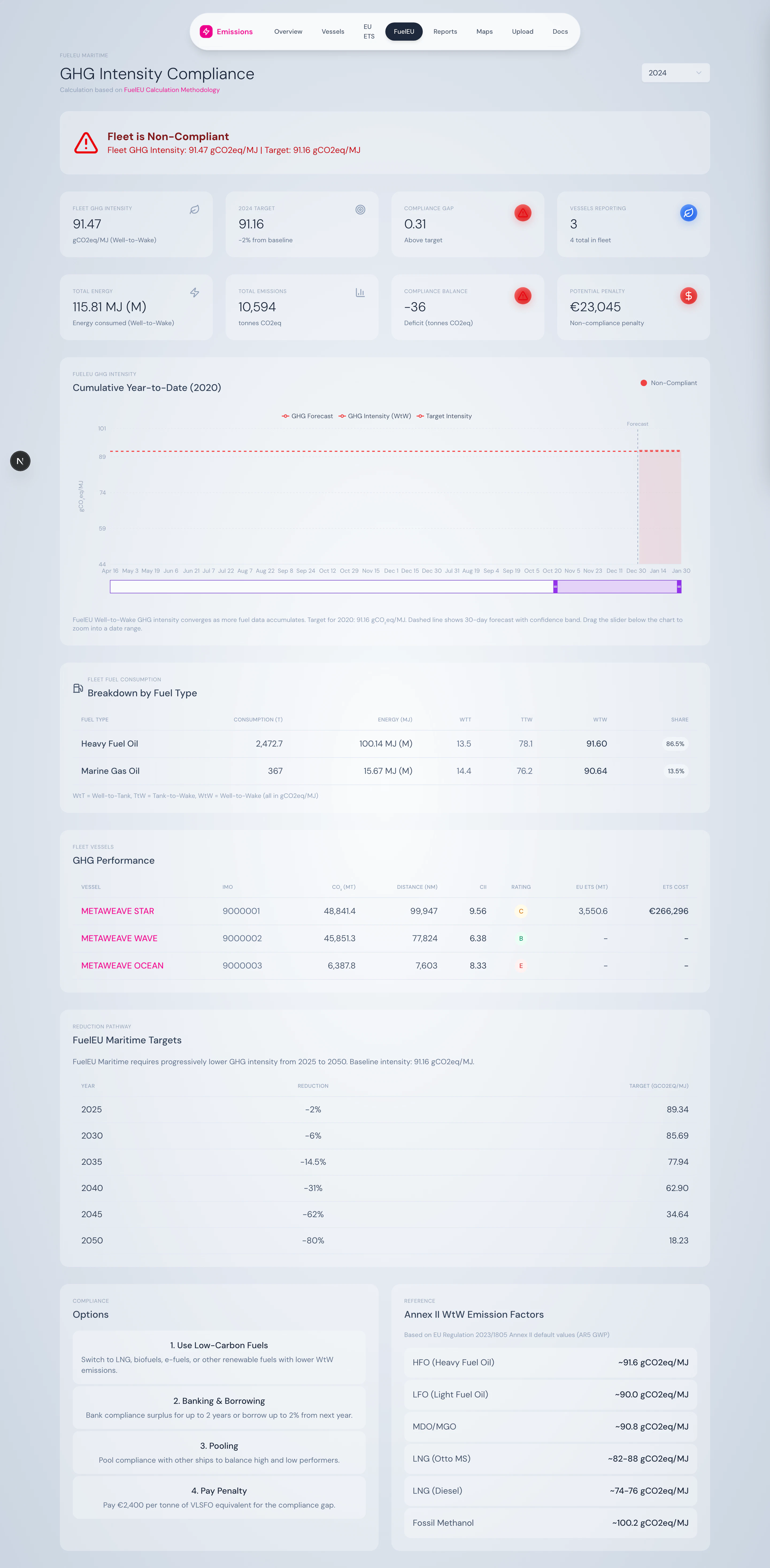 * **Compliance banner** — green or red, with the gap quantified in tonnes CO₂eq
* **Daily intensity chart** — fleet GHG intensity over the year against the target line
* **Fuel breakdown table** — consumption, energy (MJ), WtT, TtW, WtW, share %
* **Per-vessel ranking** — which vessels are pulling the fleet above target
* **Reduction pathway** — built-in reference table for 2025–2050
## Output
A **FuelEU Maritime Report** with fleet GHG intensity, fuel mix, compliance balance, and penalty projection — formatted for verifier submission. See [Reports hub](/product/reports-hub).
## Reference
### Primary regulations
* [Regulation (EU) 2023/1805](https://eur-lex.europa.eu/legal-content/EN/TXT/?uri=CELEX%3A32023R1805) — FuelEU Maritime
* [Annex II default emission factors](https://eur-lex.europa.eu/legal-content/EN/TXT/?uri=CELEX%3A32023R1805#d1e32-94-1) — WtT, TtW, LCV for every supported fuel
### Industry guides
* [DNV — FuelEU Maritime](https://www.dnv.com/maritime/insights/topics/fueleu-maritime/)
* [CE Delft — FuelEU Maritime and EU ETS Report](https://cedelft.eu/publications/eu-ets-and-fueleu-maritime/)
* [BetterSea — FuelEU Maritime Calculation Guide](https://bettersea.com/fueleu-maritime/)
* [European Sustainable Shipping Forum (ESSF)](https://transport.ec.europa.eu/transport-themes/sustainable-transport/european-sustainable-shipping-forum_en)
* [Sustainable Ships — FuelEU Penalty Calculator](https://www.sustainableships.org/fueleu-maritime/)
### GHG / GWP
* [IPCC AR5 GWP Values](https://www.ipcc.ch/assessment-report/ar5/) — source of CH₄ = 28, N₂O = 265
### In this documentation
* [Methodology: FuelEU WtW](/methodology/fuel-eu-wtw)
* **Compliance banner** — green or red, with the gap quantified in tonnes CO₂eq
* **Daily intensity chart** — fleet GHG intensity over the year against the target line
* **Fuel breakdown table** — consumption, energy (MJ), WtT, TtW, WtW, share %
* **Per-vessel ranking** — which vessels are pulling the fleet above target
* **Reduction pathway** — built-in reference table for 2025–2050
## Output
A **FuelEU Maritime Report** with fleet GHG intensity, fuel mix, compliance balance, and penalty projection — formatted for verifier submission. See [Reports hub](/product/reports-hub).
## Reference
### Primary regulations
* [Regulation (EU) 2023/1805](https://eur-lex.europa.eu/legal-content/EN/TXT/?uri=CELEX%3A32023R1805) — FuelEU Maritime
* [Annex II default emission factors](https://eur-lex.europa.eu/legal-content/EN/TXT/?uri=CELEX%3A32023R1805#d1e32-94-1) — WtT, TtW, LCV for every supported fuel
### Industry guides
* [DNV — FuelEU Maritime](https://www.dnv.com/maritime/insights/topics/fueleu-maritime/)
* [CE Delft — FuelEU Maritime and EU ETS Report](https://cedelft.eu/publications/eu-ets-and-fueleu-maritime/)
* [BetterSea — FuelEU Maritime Calculation Guide](https://bettersea.com/fueleu-maritime/)
* [European Sustainable Shipping Forum (ESSF)](https://transport.ec.europa.eu/transport-themes/sustainable-transport/european-sustainable-shipping-forum_en)
* [Sustainable Ships — FuelEU Penalty Calculator](https://www.sustainableships.org/fueleu-maritime/)
### GHG / GWP
* [IPCC AR5 GWP Values](https://www.ipcc.ch/assessment-report/ar5/) — source of CH₄ = 28, N₂O = 265
### In this documentation
* [Methodology: FuelEU WtW](/methodology/fuel-eu-wtw)