> ## Documentation Index
> Fetch the complete documentation index at: https://docs.appliedaifoundation.org/llms.txt
> Use this file to discover all available pages before exploring further.
# IMO CII
> Carbon Intensity Indicator — what it is, who it applies to, and how the platform handles it.
## What it is
CII (Carbon Intensity Indicator) is the IMO's operational efficiency metric. It measures the grams of CO₂ a ship emits per tonne (or TEU) of cargo capacity per nautical mile sailed.
Each year IMO publishes a target — the **Required CII** — and ships are graded **A through E** based on how close their **Attained CII** comes to that target.
## Who it applies to
All cargo, RoPax, and cruise ships of **5,000 GT or above** trading internationally. Ratings have been published annually since 2023 (under Regulation MARPOL Annex VI, Chapter 4).
A **D rating for three consecutive years** or a **single E rating** triggers a mandatory corrective action plan.
## What the platform calculates
For every vessel and every year, the platform computes:
* **Reference CII** — the 2019 baseline, using the IMO formula `CII_ref = a × Capacity^(-c)` with ship-type-specific `a` and `c` values
* **Required CII** — the reference reduced by the year's reduction factor (5% in 2023 rising to 19% in 2030, then 2% per year beyond)
* **Attained CII** — the actual operational result, in gCO₂ per tonne-NM
* **Rating (A–E)** — using ship-type-specific d-factors applied to the Required CII as boundary multipliers
* **Compliance margin** — Required minus Attained (positive is good)
* **Reefer-corrected CII** — the same calculation with reefer container CO₂ stripped out per [MEPC.355(78)](/methodology/reefer-correction)
## Ship types supported
Eight IMO ship-type buckets, each with its own `a`, `c`, capacity basis (DWT or GT), and rating boundaries:
| Ship type | Capacity basis | a | c |
| ------------- | -------------- | ------ | ----- |
| Container | DWT | 1,984 | 0.489 |
| Bulk carrier | DWT | 4,745 | 0.622 |
| Tanker | DWT | 5,247 | 0.610 |
| Gas carrier | DWT | 14,405 | 0.807 |
| LNG carrier | DWT | 9,827 | 0.718 |
| General cargo | DWT | 588 | 0.388 |
| Ro-Ro | DWT | 2,023 | 0.460 |
| Cruise | GT | 930 | 0.383 |
The platform automatically maps your `vesselType` field to one of these (e.g. "Crude Oil Tanker" → Tanker, "Car Carrier" → Ro-Ro).
## What you see in the product
 * **Fleet view**: A–E distribution donut, fleet-average CII, and a sortable table of every vessel's rating
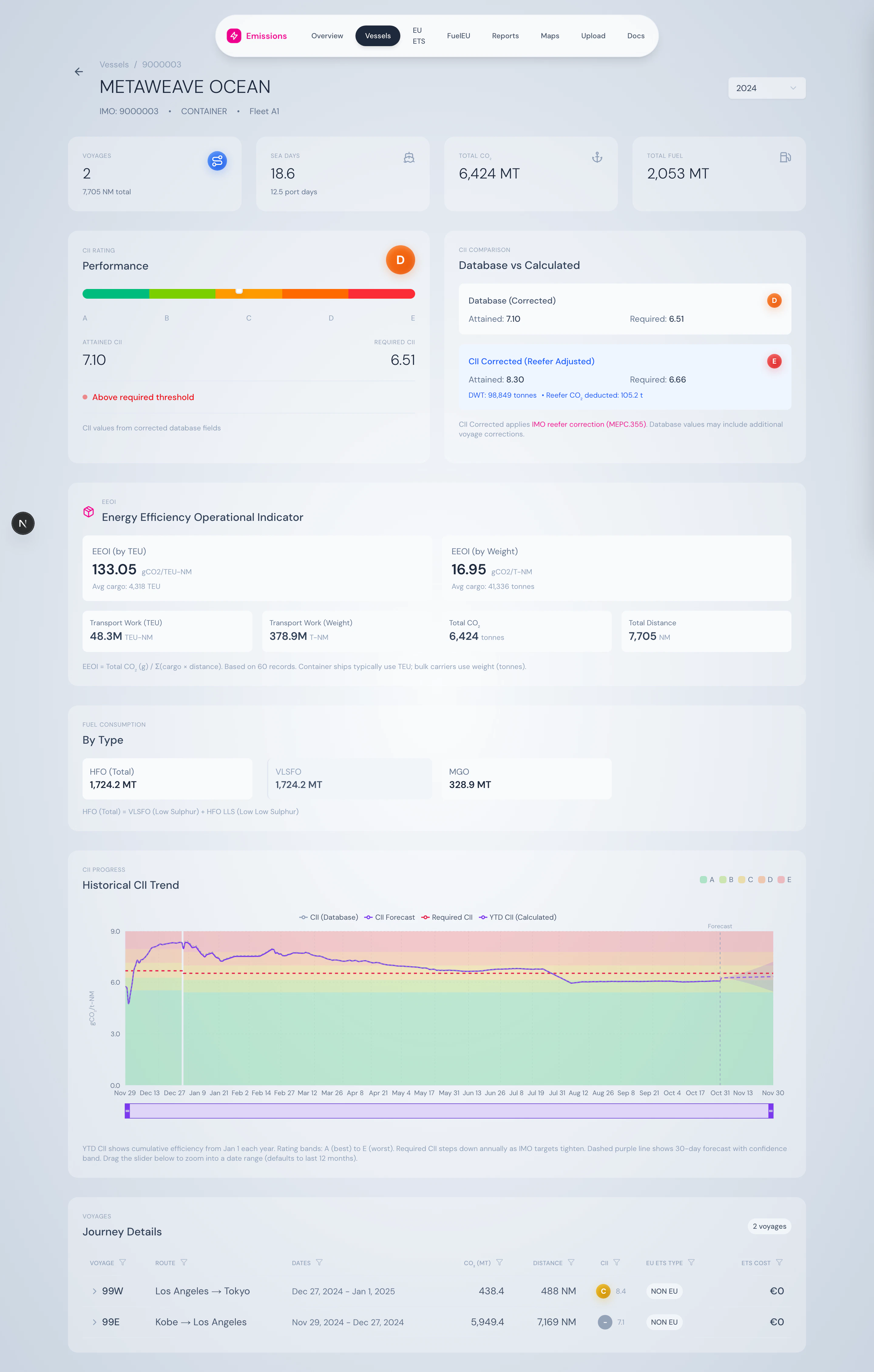
* **Vessel view**: Radial gauge plotting Attained against the A/B/C/D/E bands, side-by-side comparison of database vs. reefer-corrected CII, and a rolling chart of daily CII over 12+ months with stepped Required-CII lines per year
* **Methodology page**: Interactive calculators for Required and Attained CII so you can sanity-check inputs
## Output
A downloadable **CII Statement of Compliance** for each vessel, formatted for flag-state submission. See [Reports hub](/product/reports-hub).
## Reference
### Primary regulations
* [IMO MEPC.353(78)](https://wwwcdn.imo.org/localresources/en/KnowledgeCentre/IndexofIMOResolutions/MEPCDocuments/MEPC.353\(78\).pdf) — CII reference lines (a, c coefficients by ship type)
* [IMO MEPC.354(78)](https://wwwcdn.imo.org/localresources/en/KnowledgeCentre/IndexofIMOResolutions/MEPCDocuments/MEPC.354\(78\).pdf) — CII rating boundaries (d-vector values)
* [IMO MEPC.355(78)](https://wwwcdn.imo.org/localresources/en/KnowledgeCentre/IndexofIMOResolutions/MEPCDocuments/MEPC.355\(78\).pdf) — Reefer correction guidelines
* [IMO MEPC.339(76)](https://wwwcdn.imo.org/localresources/en/KnowledgeCentre/IndexofIMOResolutions/MEPCDocuments/MEPC.339\(76\).pdf) — AER/CII methodology and calculation guidelines
* [IMO MEPC.364(79)](https://wwwcdn.imo.org/localresources/en/KnowledgeCentre/IndexofIMOResolutions/MEPCDocuments/MEPC.364\(79\).pdf) — 2023 Guidelines on CO₂ emission factors
### Industry guides
* [DNV — CII Carbon Intensity Indicator](https://www.dnv.com/maritime/insights/topics/CII-carbon-intensity-indicator/)
* [ClassNK — CII Regulation Overview](https://www.classnk.or.jp/hp/en/activities/statutory/eexi/cii.html)
* [Open-IMO-CII-Calculator (open source reference)](https://github.com/Open-IMO/Open-IMO-CII-Calculator)
### In this documentation
* [Methodology: CII formulas](/methodology/cii-formulas)
* [Methodology: Reefer correction](/methodology/reefer-correction)
* **Fleet view**: A–E distribution donut, fleet-average CII, and a sortable table of every vessel's rating
* **Vessel view**: Radial gauge plotting Attained against the A/B/C/D/E bands, side-by-side comparison of database vs. reefer-corrected CII, and a rolling chart of daily CII over 12+ months with stepped Required-CII lines per year
* **Methodology page**: Interactive calculators for Required and Attained CII so you can sanity-check inputs
## Output
A downloadable **CII Statement of Compliance** for each vessel, formatted for flag-state submission. See [Reports hub](/product/reports-hub).
## Reference
### Primary regulations
* [IMO MEPC.353(78)](https://wwwcdn.imo.org/localresources/en/KnowledgeCentre/IndexofIMOResolutions/MEPCDocuments/MEPC.353\(78\).pdf) — CII reference lines (a, c coefficients by ship type)
* [IMO MEPC.354(78)](https://wwwcdn.imo.org/localresources/en/KnowledgeCentre/IndexofIMOResolutions/MEPCDocuments/MEPC.354\(78\).pdf) — CII rating boundaries (d-vector values)
* [IMO MEPC.355(78)](https://wwwcdn.imo.org/localresources/en/KnowledgeCentre/IndexofIMOResolutions/MEPCDocuments/MEPC.355\(78\).pdf) — Reefer correction guidelines
* [IMO MEPC.339(76)](https://wwwcdn.imo.org/localresources/en/KnowledgeCentre/IndexofIMOResolutions/MEPCDocuments/MEPC.339\(76\).pdf) — AER/CII methodology and calculation guidelines
* [IMO MEPC.364(79)](https://wwwcdn.imo.org/localresources/en/KnowledgeCentre/IndexofIMOResolutions/MEPCDocuments/MEPC.364\(79\).pdf) — 2023 Guidelines on CO₂ emission factors
### Industry guides
* [DNV — CII Carbon Intensity Indicator](https://www.dnv.com/maritime/insights/topics/CII-carbon-intensity-indicator/)
* [ClassNK — CII Regulation Overview](https://www.classnk.or.jp/hp/en/activities/statutory/eexi/cii.html)
* [Open-IMO-CII-Calculator (open source reference)](https://github.com/Open-IMO/Open-IMO-CII-Calculator)
### In this documentation
* [Methodology: CII formulas](/methodology/cii-formulas)
* [Methodology: Reefer correction](/methodology/reefer-correction)